
The Indian government addressed opposition concerns regarding the West Asia crisis in an all-party meeting, outlining its strategy for ensuring the security of the Indian diaspora, fulfilling energy needs, and maintaining diplomatic relations with key partners. The government also dismissed Pakistan's reported mediation efforts.

The joint statement was issued during Pakistan Prime Minister Shehbaz Sharif's recent visit to China.

China and Pakistan have jointly proposed a five-point peace plan to address the ongoing conflict in West Asia, focusing on de-escalation and safe passage through the Strait of Hormuz.

Pakistan is set to host face-to-face talks between the United States and Iran, aiming to solidify a fragile ceasefire and prevent further conflict in West Asia. The discussions will focus on a long-term peace arrangement, including sanctions relief, regional security, and Iran's nuclear program.

The Gulf countries on Monday welcomed a peace deal reached between the US and Iran to end their conflict and called for protection of maritime routes and freedom of international navigation, including the uninterrupted flow of traffic through the Strait of Hormuz.

Trinamool Congress MP Kirti Azad has accused the BJP of being linked to the alleged NEET paper leak, claiming that individuals associated with the ruling party are involved in the scandal. He alleges the BJP is an 'expert in theft,' citing previous instances of 'vote theft' and 'job theft'.

The NDA government has gradually nuanced its position on the issue of demographic challenge.

A lesson for India is to clearly define objectives beforehand, so that the adversary or other parties do not attempt to mitigate them midway.

If one has to compare the tenures of the two prime ministers one must credit Nehru with laying the foundations on which Modi is building a grand edifice, asserts Colonel Anil A Athale (retd).

Nobody takes Pakistan seriously and therefore Pakistan's sudden mediating with almost immediate results of a ceasefire seems more contrived than real, points out Vice Admiral Biswajit Dasgupta (retd).

Pakistan's Prime Minister Shehbaz Sharif has engaged in extensive diplomatic efforts to de-escalate the conflict in West Asia, offering to host talks between the US and Iran and engaging with leaders from Saudi Arabia, Qatar, Malaysia, the UK, China, and the European Union.

If the Iranian regime needs to be punished for promoting quasi-terrorist outfits like Hezbollah and Hamas, then what about Pakistan which has spent decades exporting terror around the world, killing thousands, particularly in Afghanistan and India? asks M R Narayan Swamy.

Through his commitment to democratic norms, debate, dissent and constitutionalism, Jawaharlal Nehru helped ensure that parliamentary democracy took deep root in independent India. Utkarsh Mishra evaluates Nehru's 17 years as India's first prime minister, examining his role in nation-building, democratic institution-building, economic planning, scientific advancement and foreign policy.

Punjab's Leader of Opposition, Partap Singh Bajwa, has criticised the government's conflicting statements regarding recent blasts, calling for transparency and accountability instead of political theatrics.

Punjab Finance Minister Harpal Singh Cheema has condemned the recent blasts in Amritsar and Jalandhar, calling them a deliberate attempt to spread terror and disrupt the state's peace. He accused the BJP of trying to create an atmosphere of fear and division for political gains ahead of elections.
The Congress party has criticised the Modi government on the first anniversary of the Pahalgam terror attack, stating that Pakistan has gained global respectability due to the failure of Prime Minister Narendra Modi's foreign policy.
Punjab Chief Minister Bhagwant Mann has accused the BJP of orchestrating recent blasts in the state, alleging it's part of their strategy for the upcoming assembly elections. The BJP has strongly refuted these claims, demanding proof or Mann's resignation, while the state DGP suggests Pakistani ISI involvement.

Opposition parties have criticised the AAP government in Punjab following twin blasts in Jalandhar and Amritsar, citing a breakdown in law and order and intelligence systems. The blasts have sparked a political blame game, with accusations flying between the AAP and BJP.

Pakistan's former captain Shahid Afridi has said he is not averse to joining politics in the future after he moved his residence from his hometown Karachi to capital Islamabad.

Haryana Chief Minister Nayab Singh Saini criticised Punjab Chief Minister Bhagwant Mann for blaming the BJP for recent blasts in Punjab, accusing Mann of losing his mental balance and making irresponsible statements.
A political row has erupted over the twin blasts in Punjab, with Chief Minister Bhagwant Mann accusing the BJP of trying to create fear ahead of next year's assembly elections. The BJP has hit back, terming the remarks condemnable and alleging that Mann ignored preliminary investigation findings pointing towards possible ISI involvement.

West Bengal Chief Minister Mamata Banerjee has criticised the deployment of CRPF armoured vehicles during the Assembly elections, accusing the BJP-led Centre of using government resources to favour their party. She also addressed concerns of potato farmers and urged them to sell their produce in other states.

Aam Aadmi Party MP Sanjay Singh has accused the BJP of orchestrating bomb blasts in Amritsar and Jalandhar to destabilise Punjab ahead of elections, a claim strongly refuted by the BJP.
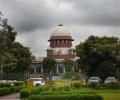
The Supreme Court has raised concerns about the low conviction rates under the Unlawful Activities (Prevention) Act (UAPA), noting that over 90 per cent of trials result in acquittals. The observations were made while granting bail to an accused in a narco-terrorism case.

'If this region destabilises, then we are not far away. This region should not destabilise.'
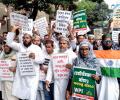
'Why are we deliberately taking apart an electoral system that has worked?' 'There is no answer to that, and there is no data and has never been any on the absurd slander that foreigners are voting here,' asserts Aakar Patel.

The extent of doubts over the fairness of this election can be assessed by juxtaposing two figures: Total votes polled by the two principal parties and the number of people who were disallowed from voting this time, observes Nilanjan Mukhopadhyay.
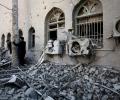
The logic of war plus the gathering storms in US politics as the midterms loom large leave him with no real alternative but to negotiate, points out Ambassador M K Bhadrakumar.

I wonder if I can rest assured -- before the election ink on my finger fades -- that my home state is at the threshold of a better future, wonders Vice Admiral Biswajit Dasgupta (retd).

Russian President Vladimir Putin has offered his support to help bring peace to West Asia, praising the Iranian people for their resilience. This comes as Iran seeks to resolve the conflict with the US, following discussions with Pakistani and Omani leadership.

Hopefully, the BJP will realise that it's the right time for parivartan (change) in its polarising poll strategies after achieving the impossible-looking goal of winning West Bengal, argues Sheela Bhatt.

India observed the first anniversary of the Pahalgam terror attack, with leaders paying homage to the victims and asserting the country's commitment to fighting terrorism.
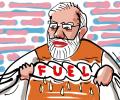
Following through announcements with enforcement of measures is key, as a run through recent Indian economic history shows, points out A K Bhattacharya.

Chinese leaders, including its generals, will have to weigh whether they can win a war if they ever attack Taiwan and if at all, can they sustain the subsequent devastation, notes Rup Narayan Das.
BJP leader Tarun Chugh has served a legal notice to Punjab CM Bhagwant Mann for linking the BJP to recent blasts, demanding proof or resignation.

Congress chief Mallikarjun Kharge's remark calling Prime Minister Narendra Modi a 'terrorist' has triggered strong reactions from the BJP, who have demanded an apology from Congress leader Rahul Gandhi and Tamil Nadu Chief Minister M K Stalin.
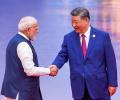
For India, China's Indian Ocean power projection, maritime domain awareness, dual-use ports, underwater surveillance, antisubmarinewarfare, naval exercises with Pakistan, pose considerable pressure, depleted India's strategic depth and marginalises Indian role, points out Srikanth Kondapalli.

'Should China's interest in the Teesta River projects be approved, it would likely result in heightened Chinese presence near the Siliguri corridor.'

Iran's foreign ministry spokesperson Esmaeil Baqaei on Sunday said that the recent meeting with US officials was the longest round of negotiations they have had in the past year.

Trump repeated the assertion that Sharif had claimed he saved "25 million lives" when he stopped the war between India and Pakistan.
